Behind the Frame: Fallen Angel
It was late afternoon in Basel, the kind of light that has given up its heat but not its color. I had no plan and no expectation, just walking, looking, the way you do when nothing in particular has happened yet. Then I saw the wings.
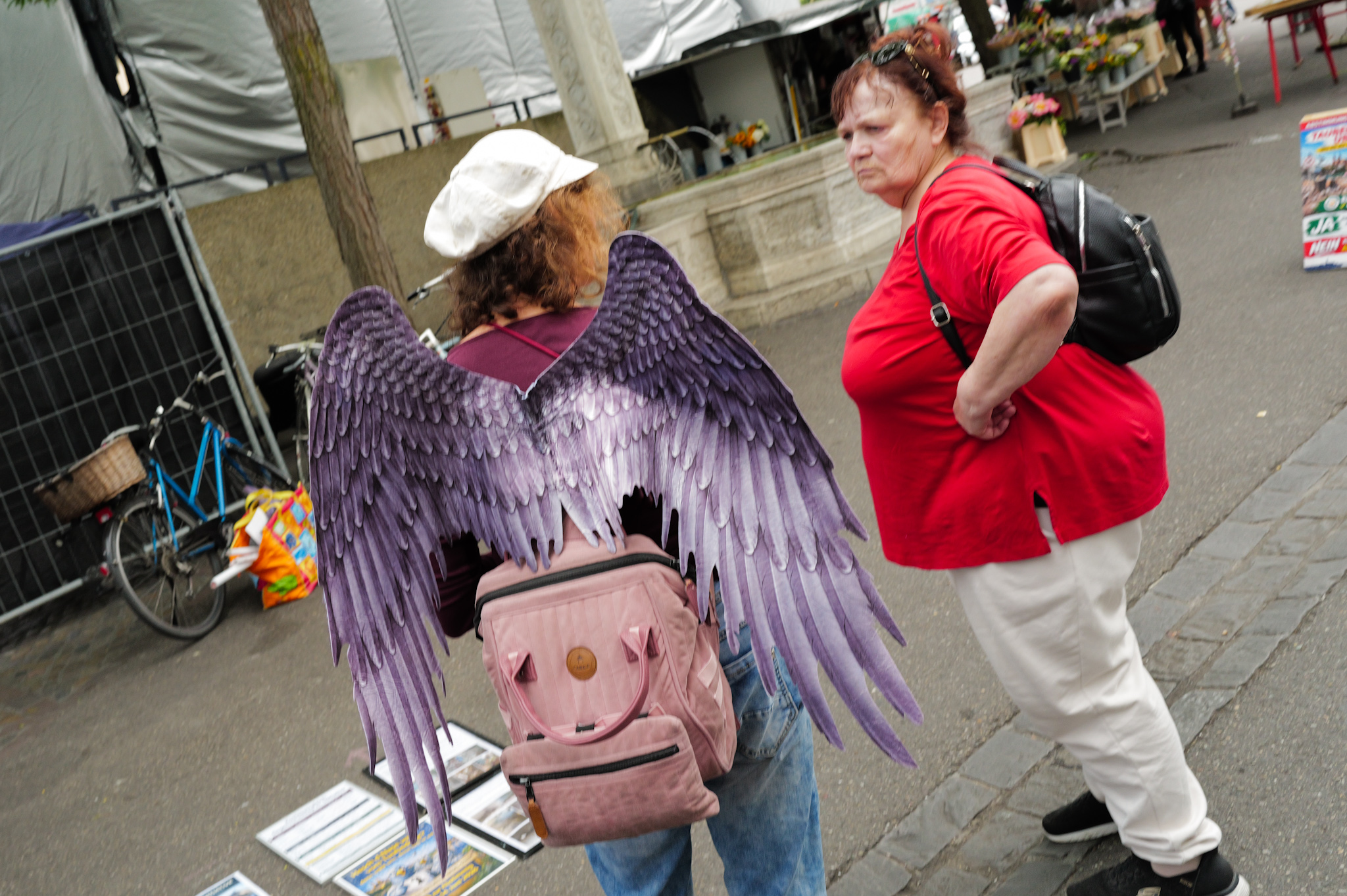
A woman was wearing them: a pair of wings, purple, strapped to her back, out of place on an ordinary street among ordinary people. And she had a small backpack on too, which somehow made it better. An angel with a backpack is even more impossible than an angel: too human, too ordinary, an errand-runner with wings. I don’t know what she was doing there. I never found out. That not-knowing is part of why the picture works: an angel with no explanation is better than an angel with one.
I had a second, maybe two. There was no time to think about the horizon, no time to check the light, no time to decide whether the exposure was right. You hope the settings you left on the camera are still close enough, you hope the light hasn’t shifted, and you shoot. Because the only thing that matters in that instant is what’s in front of you. Everything else, the technique, the perfection, the rules, can wait, or can be forgiven later. The subject is the whole point.
This was neither of the two ways you usually work a street. There’s fishing: you find a good background, a patch of light, a frame that already means something, and you wait for the right person to walk into it. And there’s hunting: you spot an interesting subject and you follow it, hoping a second element will arrive, a backdrop, another figure dressed in answer or in contrast, something that turns a subject into a picture. Both of those give you time. You build, or you stalk, but you get to wait. This was neither. The scene was already complete the instant I saw it: the wings, the red, the two of them, nothing to wait for, nothing to chase. There was only my reaction, and the one second I had to get it right. You can’t be shy in that second. Henri Cartier-Bresson had a phrase that fits images à la sauvette, images grabbed on the run, on the fly, almost stolen. But honestly, in a moment like that I think of Garry Winogrand more than anyone: tilt the horizon, blow the exposure, who cares, get the thing. Shoot first, and let the frame be alive rather than correct.
In the picture, the woman in red has been stopped by the angel, caught mid-exchange, addressed, held there for a moment by a stranger with purple wings. She has no idea I’m there. Neither of them does. The two of them are having their own small encounter, and I’m a third presence neither one registers, the only one who sees the whole picture. That’s the quiet pleasure of street photography: a scene assembles itself in front of you, complete, and you’re the only witness to it.
I keep coming back to Wim Wenders’ Wings of Desire, Der Himmel über Berlin, “the sky over Berlin.” Angels move through the city listening to the private thoughts of strangers, invisible, longing to touch a world they can only watch. That’s close to what a street photographer does. You drift through other people’s lives, near enough to catch them, far enough that they don’t feel you there. You witness without being witnessed. But my angel did something Wenders’ angels never can: she reached out. She stopped someone, spoke to her, broke the glass between watching and touching, while I stayed on the other side of it, the real invisible one in the frame. And every so often, if you’re paying attention, the city hands you an angel, a fallen one, on a sidewalk, in the wrong place, purple wings and no explanation, and gives you exactly one second to believe it.
I wasn’t ready. That’s the point. You’re never ready. You just have to be looking.